
Jesuit Homecoming: New Orleans Football Photography
I have photographed a lot of nights in thirty-two years of doing this. Homecoming at my son's school is not like the others.
Jack is a junior at Jesuit and he plays in the drumline. So on homecoming night I was on the field with a camera and a credential, and I was also just a dad standing in the dark watching his kid work. Those two jobs do not always agree with each other.
The Drumline Gets There First
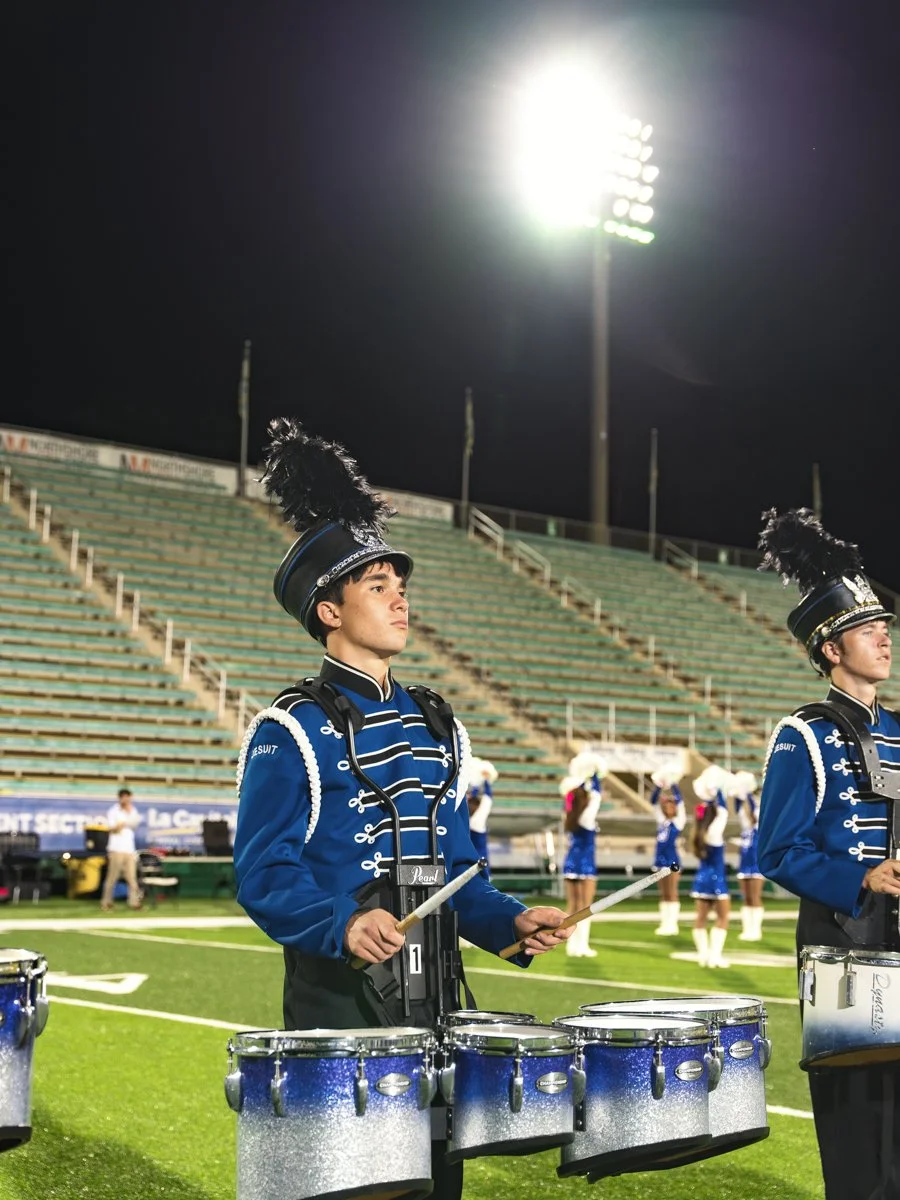
Long before anything happens on the scoreboard, the band is already working. The drumline came out in full uniform, plumes up, snares and tenors catching the tower lights, and set up to wait for a cue.
That is Jack in the first photo. Sticks up, chin level, looking off at something past my shoulder, with the stands still mostly empty behind him and one light tower burning over the top of it all.
There is no action in that frame. Nobody is scoring. He is just standing there in full uniform on a football field on a Friday night in the fall, and it is the picture from that night I would keep if I could only keep one.
I will admit the obvious, too. It is harder to photograph your own kid well, because you know him too well to see him. I made myself shoot him the way I would shoot anybody else's son: find the light, wait for the posture to settle, do not take the easy frame.
Then the Other Kind of Photo
The second frame is the opposite of the first.
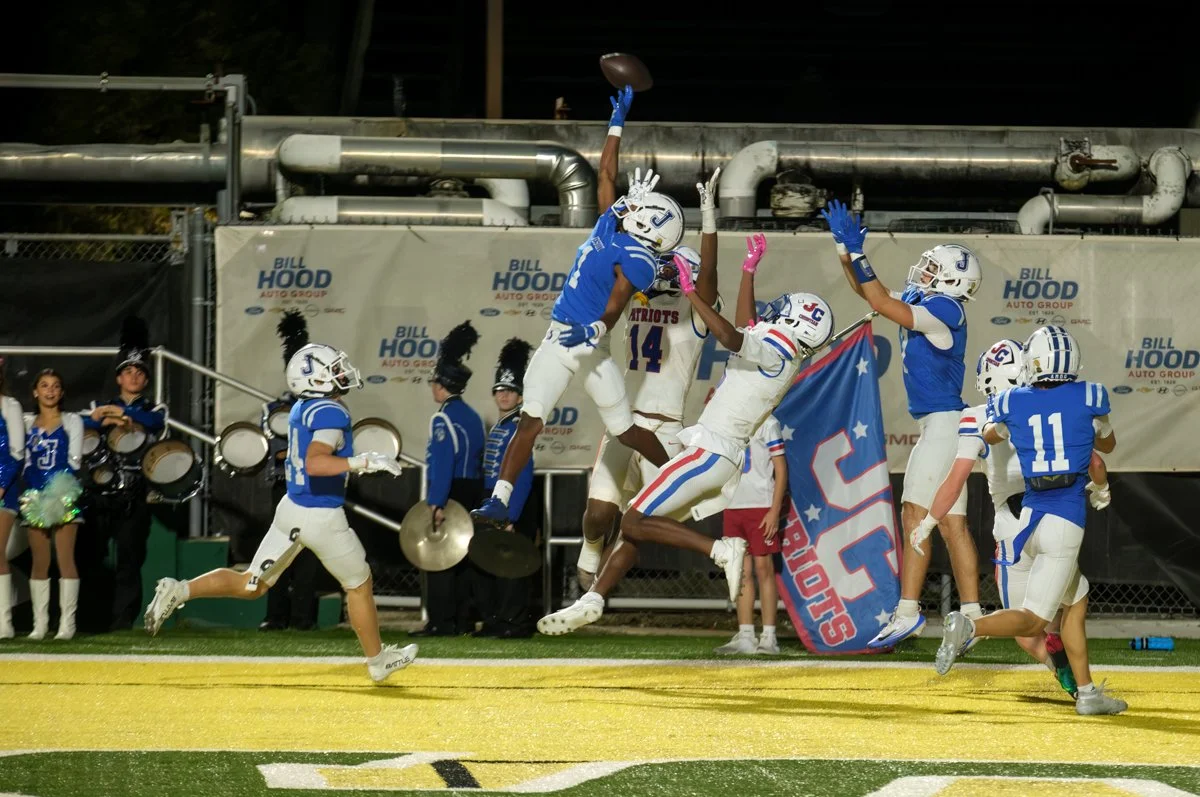
Ball in the air at the back of the end zone. A Blue Jay up above the pile with a hand on it. Two Curtis defenders climbing with him, another Jesuit player coming hard from the left, and a Patriots flag snapping on the sideline behind all of it.
You do not plan a photo like that. You plan the position that lets it happen. I was low and wide of the end zone with a long lens, already focused on the back line, and when the ball went up there was maybe a second and a half to make something of it.
That is most of sports photography. Anticipate, then react. The reacting part is easy. The standing in the right place for two hours part is the job.
What Stadium Light Actually Does
High school stadium lighting is harder than it looks. It is uneven, it can flicker at frequencies your shutter will find, and it falls off fast the moment a player steps out of the bright zone.
So I shoot wide open, keep the shutter fast enough to freeze a jump, and let the ISO go wherever it has to go. A little noise is a much smaller problem than motion blur. I would rather hand a parent a slightly grainy frame of their kid at the top of his leap than a clean frame of a smear.
I also learn where the light actually lives. There are pockets under the towers a full stop brighter than the rest of the field, and if a play is heading that way, that is where I want it to happen.
It is the same problem I work through every time I photograph a stage production, and I wrote about that after shooting Legally Blonde at Rivertown Theaters.
Why I Shoot the Whole Night
Here is what I did not understand when I started covering games. Almost nobody is looking at these photographs tonight. They are looking at them in ten years.
The kid in the drumline becomes somebody's dad. The receiver at the top of that jump ends up at a reunion telling the story his own way. The pictures are not really about the game. They are proof that this particular Friday, under these particular lights, with these particular people, actually happened.
That is why I photograph the band as carefully as I photograph the offense. The game gets a scoreboard. Everything around the game only gets photographs.
If your school, team, booster club, or program in the New Orleans area needs somebody on the sideline, I would like to hear about it.
Call or text 504-957-8412 to commission GK — gkphotography.com